Textile Manufacturing Ontology
Comprehensive knowledge engineering and semantic validation framework for the carpet weaving process, utilizing formal modeling and SHACL rules.
Overview
This repository contains a comprehensive knowledge engineering solution applied to the textile manufacturing sector. The project demonstrates the application of semantic modeling principles and rigorous data validation in a real-world industrial scenario.
Key Concepts and Ontology Construction
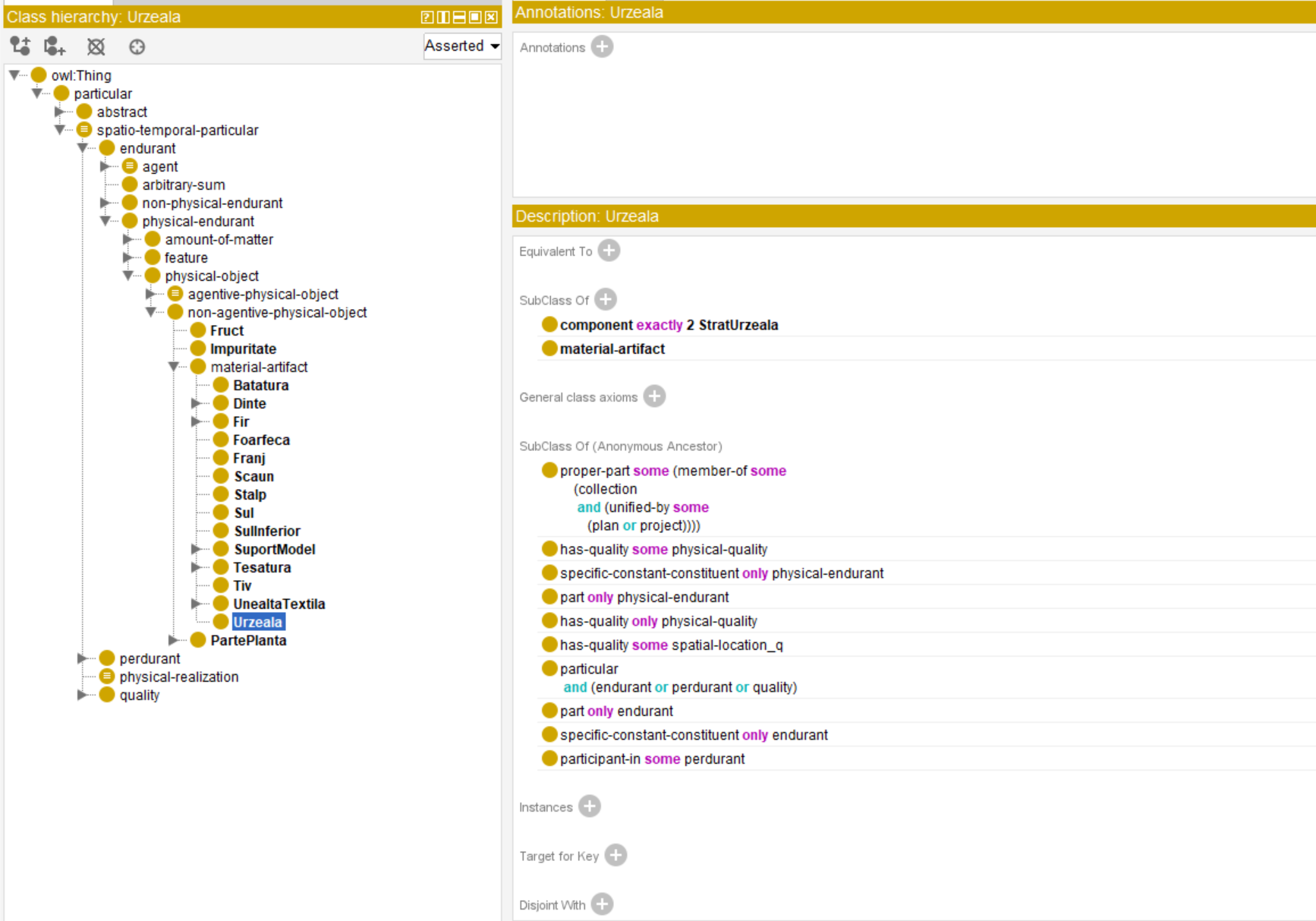
The core of this project is the construction of a formal ontology mapping the carpet weaving process. The ontology was built using the following methodology:
-
Alignment with Upper-Level Ontologies: To ensure semantic interoperability and a robust conceptual foundation, the domain-specific classes and properties are strictly aligned with established top-level ontologies:
- DOLCE-Lite: Used for the core categorization of entities (e.g., mapping wool to
Amount of Matteror weaving tools tomaterial-artifact). - Extended-DnS (Descriptions and Situations): Applied to model complex processes, tasks, and the specific roles entities play within the manufacturing workflow (e.g., using
extended-dns:makes). - SpatialRelations: Utilized to define the precise spatial alignments and physical dependencies between loom components.
- TemporalRelations: Implemented to enforce chronological sequences and time-bound constraints across the various stages of weaving and dyeing.
- DOLCE-Lite: Used for the core categorization of entities (e.g., mapping wool to
-
Taxonomy and Concept Definition: The ontology defines a strict hierarchy of concepts derived from standard dictionary definitions. For example, the concept “Lână” (Wool) is classified as a “Fibra” (Fiber). Processes like “Tundere” (Shearing) are mapped to “task,” while artifacts like “Daracitor” (Carding machine) are categorized accordingly.
-
Formal Restrictions: The ontology implements specific restrictions to define the relationships between concepts formally. For instance, a “Daracitor” (Carding machine) must have a “Dinte” (Tooth) as a part (
Dărăcitor(x) → ∃y,t(Dinte(y) ∧ T(t) ∧ part(x,y,t))). A “FirVopsit” (Dyed Yarn) must have a specific “Culoare” (Color) quality (FirVopsit(x) → Fir(x) ∧ ∃y,t(Culoare(y)∧ has-quality(x,y,t))). -
Semantic Rules (SWRL): The logic of the manufacturing process is enforced using Semantic Web Rule Language (SWRL).
- One rule specifies that the “Daracit” (Carding) process transforms raw wool (“LanaBruta”) into carded wool (“LanaDaracita”).
- Another rule dictates that the extraction process (“Extragere”) from a plant part (“PartePlanta”) results in a plant extract (“ExtractPlanta”).
-
Consistency Verification: The logical consistency of the resulting ontology was successfully verified using the Ontop framework connected to a MySQL database (
tesut_covoare_db).